Pages

Showing posts with label WWE2014. Show all posts

Friday, September 4, 2015

Women of Genre Fiction challenge - completed


There is a lot of good discussion right now in the science fiction community about under-represented groups. I won't weigh in on anyone else's opinions, but here's mine.

When I was a kid I didn't have a lot of friends. We moved around a lot and I wasn't very good at fitting in at new schools. So I read a lot. Books didn't reject me and when I was reading I didn't need anyone else. I eventually made friends where I was, but they were always uneasy relationships. I always felt on the verge of being rejected. Even now that little voice inside me that talks on behalf of my social anxiety tells me that my friends, who I am otherwise quite confident in, are just putting up with me.

Books have always been an escape from that feeling. They were sources of new worlds to learn about and distractions from the real world. In them there were people like me to reassure me that I wasn't alone and people unlike me to remind me that we are all unique. When I was a kid I needed more of the former than the latter and I was lucky that there are lots of books with people like me. There were even more books where boys were the protagonist. In fact, there are gobs of young-man's-epic-journey books or men's adventure stories.

I seek out books written by women because I know, for sure, that the author has the life experiences to empathize with woman and see them as vital and valuable human beings, to see me as a valuable human being. Female authors are also examples to me, showing me that my creative works can be as good as a man's and can be taken as seriously. And by seeking them out and recognizing their worth I am contributing to that equality. All of that on top of getting to read the amazing stories that spring from their heads.

Men might seek out books written by women for different reasons. Perhaps those reasons are similar to why I seek out books written by people of different racial, cultural, gender, and sexual identities than my own. I like to learn about other people's experiences. I like to be taken out of my own head and surroundings and into someone else's. Authors who have different views of the world are in the best position to expose me to stories, characters, and settings that are foreign to me.

For the past two years, as part of the Worlds Without End Roll Your Own challenges I have challenged myself to read 12 books by 12 woman authors that are new to me. It's a surprisingly easy challenge as there are lots of women whose works I haven't read and more and more women debuting every year.
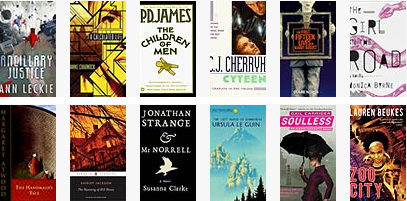

In 2014's challenge I took on some legendary books:


I also found some new books that I loved:


In all, I only outright disliked one book, Children of Men by PD James

Last year's success made this year's challenge an imperative and I am once again happy with the results.


This year I found:
  • Robin Hobb's Farseer Trilogy which not only made me rethink my avoidance of high fantasy but also was one of the most satisfying endings I've ever read
  • Pat Cadigan, whose book Synners feels like a part of me now.
  • Elizabeth Bear and, while Dust wasn't my favorite book this year, I loved the casual inclusion of lesbians and genderqueer characters.
  • Nalo Hopkinson's Brown Girl in the Ring, which has been on my list forever. Everyone must be hanging on to their copies because I check the used bookstore every time I go. I loved how the book was about an immigrant community in Toronto and so mixed Afrocaribbean elements against a familiar urban backdrop. Peter Jay Fernandez did an excellent job narrating the audiobook and if I ever get my hands on a physical copy I'll probably still hear his voice.
  • Lagoon by Nnedi Okorafor. It's a great example of how expectations can shape a book experience. This is a big-picture book. Though it zooms in on scenes and follows a few characters, this is the story about Lagos, not the individual characters. Once I understood that I liked it better.
  • Redemption in Indigo by Karen Lord. Another great audiobook. The book is written as a folktale told orally, so audio is the way to experience it.
  • The Golem and the Jinni by Helene Wecker. I keep thinking I should describe this book in some other way than "relaxing" and "a story of friendship" because that makes it sound boring, but it was both of those things and not at all boring. A lot of books are sold based on their intensity, and I love some of those books, but this one is perfect in the way it helped all of my worries and thoughts melt away while I lived the lives of the two main characters.
  • The Goblin Emperor by Katherine Addison. Yet another great audiobook. It might not be the most groundbreaking book, but I loved how the protagonist won by being reasonable and not a jerk.
  • The Buried Life by Carrie Patel, Revision by Andrea Phillips, and The Alchemy of Stone. All of which I liked well enough, but not enough to stay fresh in my memory even after a few months.

Having finished this challenge already feels great. The next official "reading level" for the 2015 Women of Genre Fiction was 24 books, and I won't quite make that, but I do have 7 more books on The Spreadsheet that are new-to-me women authors:

Despatches from the Frontiers of the Female Mind (already read)
Doomsday Morning
Memory of Water
The Bohr Maker
The Snow Queen
The Three
Where Late the Sweet Birds Sing

Any recommendations on which of these to read first or female authors I should make sure to read?

Sunday, August 2, 2015

Reader's Choice Award - Completed


Last year I challenged myself to pick one year and one science fiction award and read all of the nominees. I wanted to decide for myself who should have won that year. My year was 2008 and my award was the Hugo Award. 2008 may not hold a special place in my heart, but the Hugo Award does. Despite recent controversies, winners are mostly good books picked from a list of five popular science fiction novels for any given year. That's not to say they're all classics, but there are a lot of classics represented. On top of that, I was lucky enough to WorldCon in 2013. This was the last Sad Puppy free year and it was an amazing experience. The people, the panels, everything was amazing. I can't wait to make it to another WorldCon someday. The people there, the people who vote for the Hugo Award, were genuinely enthused by and proud of science fiction literature.

The nominees were, in aphabetical order:

Brasyl by Ian McDonald
Halting State by Charles Stross
The Last Colony by John Scalzi
Rollback by Robert J Sawyer
The Yiddish Policemen's Union by Michael Chabon (winner)


I didn't think too much about my choice of 2008, but there were points where I regretted it. My least favorite was Rollback by Robert J Sawyer. I was not surprised by this. I am not a Sawyer fan. It started with Flashforward, which I liked. I'm afraid to go back and read it to find out if I still like it because it was one of my first scifi books as an adult and I don't know that I had the chops to evaluate its merit yet. I'm not saying that anyone has to be well read to judge a book, any book; I'm saying that as the breadth and depth of my genre reading has increased I find myself more easily annoyed by books with interesting premises but which fail to follow through on being interesting.

Rollback follows the story of an old man whose wife decoded the first alien communication to Earth. By the time the response is received, this time not just cryptic but encrypted. Of course, with the alien 18.8 light years away, time is ticking for our old woman. A kabillionaire offers to give her a life-extending treatment called a "rollback". She insists that her husband get the treatment too, but it works on him and not her. Instant drama and interesting premise.

The problem comes in when you realize that once again a Sawyer book is about something and not in a subtle way. This one is about abortion. Other Sawyer books are about god (Calculating God) and souls (The Terminal Experiment) and free will (Flashforward). I sense that he's working through his religious issues here. If he wasn't doing it in a way that gave the impression that he is trying to balance what he senses are the Opinions of other scifi writers I might care what he had to say about these things. If I never have to read (or listen to) another book by Robert J Sawyer it will be too soon. Alas, many completionist challenges I could set include his novels. For example, if I wanted to read all of the Hugo winners, he has one novel that's a winner that I haven't read yet.


Since I started with my least favorite, we might as well count down to my personal Reader's Choice winner. Number 4, disliked on its own merits and without my Sawyer baggage: The Yiddish Policemen's Union by Michael Chabon.

This won in 2008 and I can see why someone might like it, but I'm at the same time baffled that it beat so many other books that I enjoyed (well...the three other Hugo nominees at least). First, it's barely science fiction. Since this is my award (the "Reader's Choice Award" not the Hugo), I've decided that only books that capture my imagination are scifi enough to win. The premise, a detective story set in a Jewish state carved out of Alaska, is ok, but the writing bleeds purple prose and vomits noir.


I got so slogged down that I felt like Artax in the Swamps of Sadness. I came so close to giving up but my challenge kept tugging me along. Unlike Artax, I survived.


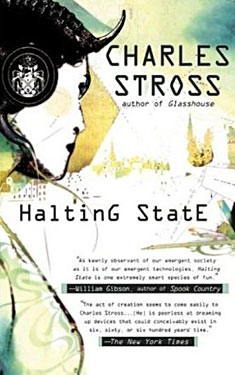
Now we're into the books I liked, starting with Halting State by Charles Stross. This was my first book by Stross though I've heard that his books can be a difficult read for someone unfamiliar with technical jargon. While I found that true, I was able to hobble along and enjoy this one.

Halting State is about what happens when infrastructure doesn't keep up with technology. It's a scary story if you're scared of things like hackers gaining access to your car via your car's cellphone connection. Particularly, when virtual worlds (like MMORPGs) have unexpected consequences in the real world. Neal Stephenson's Reamde has a similar theme though with a plot different enough from this one to not make reading both repetitive.

...and, yes, it's written in the 2nd person. Throughout the entire book "you" do everything. It takes some getting used to, but it was done very much with a purpose. Stross wants the reader to experience the book like augmented reality. He has crafted a story for you to play through. I am good at achieving immersion in books, so this trick worked perfectly on me. Your mileage may vary.

My biggest problem with the book was that a plot element would be set spinning and the reader was expected to keep that element spinning while the book went off and set other things spinning. I couldn't keep it all in my head at once. It's not enough to stop me from reading more Stross some day, but enough for me to place this one in the middle of my rankings.


The Last Colony by John Scalzi was a very close 2nd when I sat down to decide which book gets my gold star. This is the 3rd installment of Scalzi's Old Man's War series and continues the tradition of being enjoyable and book that is easy to melt into. Scalzi'a writing is uncomplicated in the best way; It's approachable. You don't need the patience of a saint to wade through dense prose or the knowledge of a software coder to understand what is going on.

Old characters John Perry and Jane Sagan have settled down to colonize, the promised reward to anyone willing to join the military, but trouble follows them and they are soon drawn into war again.

And the winner is...


...Brasyl by Ian McDonald. This book is beautiful and complex. If each theme and character were a dancer, Ian McDonald has choreographed a ballet. The three stories told are: the story of Marcelina, a reality television producer who chases a show idea until she's over head; the story of Edson, living in our future where everything is tagged with RFIDs and quantum computing is a reality; and the story of Father Luis Quinn, sent to bring a rogue priest back into line.

Each story not only explores the primary theme of multiple dimensions, but also, more subtly,  the themes of the adaptability of language and the mutation of religion. All of these themes, combined with complicated characters and vivid descriptions, captured my imagination. I will be reading more Ian McDonald and choose this book as my winner.

-------------------------------------------------------

When I think back over this challenge and the year so far, I'm not sure that I would do the challenge again. I like the idea of it, of looking back on a year and an award, even knowing the limitations of that award, and choosing for myself. If I had gone to WorldCon that year would my vote for Brasyl have swayed anything? Problably not. after all, in 2013 I voted for 2312 for the best novel but Red Shirts won. But I read every book for 2013 and made an educated vote. And now I have the same satisfaction for the group of books nominated in 2008. It's an experience that I recommend.