
There is a lot of good discussion right now in the science fiction community about under-represented groups. I won't weigh in on anyone else's opinions, but here's mine.
When I was a kid I didn't have a lot of friends. We moved around a lot and I wasn't very good at fitting in at new schools. So I read a lot. Books didn't reject me and when I was reading I didn't need anyone else. I eventually made friends where I was, but they were always uneasy relationships. I always felt on the verge of being rejected. Even now that little voice inside me that talks on behalf of my social anxiety tells me that my friends, who I am otherwise quite confident in, are just putting up with me.
Books have always been an escape from that feeling. They were sources of new worlds to learn about and distractions from the real world. In them there were people like me to reassure me that I wasn't alone and people unlike me to remind me that we are all unique. When I was a kid I needed more of the former than the latter and I was lucky that there are lots of books with people like me. There were even more books where boys were the protagonist. In fact, there are gobs of young-man's-epic-journey books or men's adventure stories.
I seek out books written by women because I know, for sure, that the author has the life experiences to empathize with woman and see them as vital and valuable human beings, to see me as a valuable human being. Female authors are also examples to me, showing me that my creative works can be as good as a man's and can be taken as seriously. And by seeking them out and recognizing their worth I am contributing to that equality. All of that on top of getting to read the amazing stories that spring from their heads.
Men might seek out books written by women for different reasons. Perhaps those reasons are similar to why I seek out books written by people of different racial, cultural, gender, and sexual identities than my own. I like to learn about other people's experiences. I like to be taken out of my own head and surroundings and into someone else's. Authors who have different views of the world are in the best position to expose me to stories, characters, and settings that are foreign to me.
For the past two years, as part of the Worlds Without End Roll Your Own challenges I have challenged myself to read 12 books by 12 woman authors that are new to me. It's a surprisingly easy challenge as there are lots of women whose works I haven't read and more and more women debuting every year.
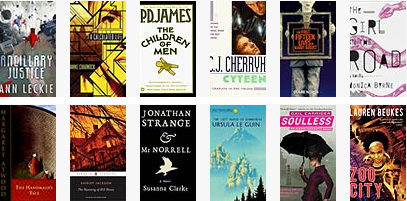
In 2014's challenge I took on some legendary books:
- Cyteen by CJ Cherryh
- The Handmaid's Tale by Margaret Atwood
- The Haunting of Hill House by Shirley Jackson
- The Left Hand of Darkness by Ursula K Le Guin.
I also found some new books that I loved:
- Ancillary Justice by Ann Leckie
- The Girl in the Road by Monica Byrne
- The First Fifteen Lives of Harry August by Claire North
- Zoo City by Lauren Beukes.
In all, I only outright disliked one book, Children of Men by PD James
Last year's success made this year's challenge an imperative and I am once again happy with the results.

This year I found:
- Robin Hobb's Farseer Trilogy which not only made me rethink my avoidance of high fantasy but also was one of the most satisfying endings I've ever read
- Pat Cadigan, whose book Synners feels like a part of me now.
- Elizabeth Bear and, while Dust wasn't my favorite book this year, I loved the casual inclusion of lesbians and genderqueer characters.
- Nalo Hopkinson's Brown Girl in the Ring, which has been on my list forever. Everyone must be hanging on to their copies because I check the used bookstore every time I go. I loved how the book was about an immigrant community in Toronto and so mixed Afrocaribbean elements against a familiar urban backdrop. Peter Jay Fernandez did an excellent job narrating the audiobook and if I ever get my hands on a physical copy I'll probably still hear his voice.
- Lagoon by Nnedi Okorafor. It's a great example of how expectations can shape a book experience. This is a big-picture book. Though it zooms in on scenes and follows a few characters, this is the story about Lagos, not the individual characters. Once I understood that I liked it better.
- Redemption in Indigo by Karen Lord. Another great audiobook. The book is written as a folktale told orally, so audio is the way to experience it.
- The Golem and the Jinni by Helene Wecker. I keep thinking I should describe this book in some other way than "relaxing" and "a story of friendship" because that makes it sound boring, but it was both of those things and not at all boring. A lot of books are sold based on their intensity, and I love some of those books, but this one is perfect in the way it helped all of my worries and thoughts melt away while I lived the lives of the two main characters.
- The Strange and Extraordinary Tale of Mirror and Goliath by Ishbelle Bee. After several months my rage at this book is starting to subside and I'm terrifically tempted to read the sequel even if it renews my fury. Someone please tip me in one direction or the other.
- The Goblin Emperor by Katherine Addison. Yet another great audiobook. It might not be the most groundbreaking book, but I loved how the protagonist won by being reasonable and not a jerk.
- The Buried Life by Carrie Patel, Revision by Andrea Phillips, and The Alchemy of Stone. All of which I liked well enough, but not enough to stay fresh in my memory even after a few months.
Having finished this challenge already feels great. The next official "reading level" for the 2015 Women of Genre Fiction was 24 books, and I won't quite make that, but I do have 7 more books on The Spreadsheet that are new-to-me women authors:
Despatches from the Frontiers of the Female Mind (already read)
Doomsday Morning
Memory of Water
The Bohr Maker
The Snow Queen
The Three
Where Late the Sweet Birds Sing
Any recommendations on which of these to read first or female authors I should make sure to read?

